Why Static Rules Engines Are Killing Your E-Commerce Growth (And How Agentic AI Fixes It)
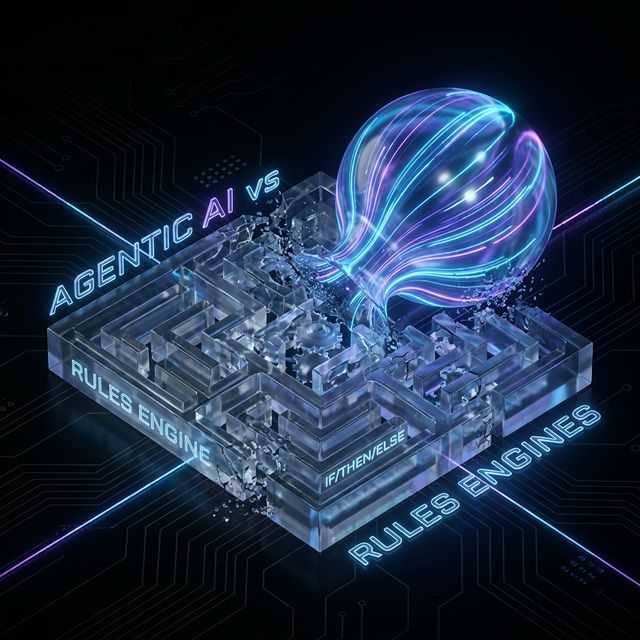
Why Static Rules Engines Are Killing Your E-Commerce Growth (And How Agentic AI Fixes It)
If you are a CTO or Head of Product at a scaling e-commerce brand, your personalization stack probably looks like a Jenga tower of "if/then" statements.
- If user buys hiking boots -> Recommend wool socks.
- If user is from California -> Show summer collection.
- If user abandons cart -> Send email #4.
This is Rules-Based Personalization. It works—until it doesn't. As your catalog grows to thousands of SKUs and your customer base diversifies, maintaining these rules becomes a logistical nightmare. You end up with "logic conflicts" (recommending winter coats to someone buying a swimsuit because it's December) and a maintenance burden that slows down feature releases.
Enter Agentic AI.
The Problem with Rules Engines
Rules engines are deterministic. They assume you, the operator, can predict every possible customer journey and encode a logic path for it.
But customer behavior is stochastic (random) and highly contextual.
A customer buying a "black dress" might be going to a funeral, a gala, or a goth rave. A rules engine sees Category: Dress + Color: Black. It doesn't see the intent.
The Maintenance Trap
Every new product category requires new rules.
- Launch a "Home Goods" section? Better write 50 new
if/thenlogic blocks. - Expand to a new region? Time to duplicate and tweak those rules for local execution.
Your engineering team stops building features and starts managing configuration files.
The Shift: What is Agentic AI?
Unlike a rules engine, an AI Agent is goal-oriented, not path-dependent.
Instead of hardcoding the path:
"If X, then Y."
You give the Agent a goal and tools:
"Goal: Maximize Average Order Value (AOV) while maintaining customer satisfaction score > 4.5. Tools: Product Catalog, Customer History, Reviews API, Inventory System."
The Agent then decides the best action in real-time.
Real-World Example: The "Hiking Trip"
Scenario: A user puts "Men's Trail Runners" in their cart.
The Rules Engine Approach:
It triggers a hardcoded cross-sell rule: Category: Shoes -> Recommend: Socks.
Result: User sees a generic pack of white cotton athletic socks.
The Agentic AI Approach: The Agent analyzes the context:
- Item: Technical trail runners (implies rugged usage).
- History: User previously bought a hydration pack.
- External Data: Review analysis shows these specific shoes run narrow.
The Agent's Decision: Instead of generic socks, it recommends:
- Merino Wool Hiking Socks (Context: Trail running).
- Blister Prevention Balm (Context: "Rugged usage").
- A specific "Thin" sock variant (Context: "Shoes run narrow").
The result isn't just a recommended product; it's a curated solution.
The Tech Stack: How It Works
This isn't magic; it's modern infrastructure.
-
Vector Database (The Memory): We use vector embeddings (via tools like
pgvectoron Supabase) to store your entire catalog not just by keywords ("red shirt") but by semantic meaning ("breathable urban activewear"). -
LLM as the "Reasoning Engine": When a request comes in, the Large Language Model (LLM) acts as the brain. It retrieves relevant context from the Vector DB and decides which products essentially "solve" the user's current problem.
-
Guardrails: To prevent hallucinations, we wrap the Agent in strict logical constraints (e.g., "Never recommend out-of-stock items," "Never recommend competitors' brands").
Is Your Stack Ready for 2025?
If your team is spending more time managing JSON configuration files than building new experiences, you are stuck in the Rules Engine era.
Agentic AI isn't just "smarter"; it's more scalable. It allows you to add 10,000 new SKUs without writing a single new rule. The system simply "understands" the new products and begins recommending them immediately where relevant.
The Edesigno Audit
We specialize in migrating high-volume retailers from brittle rules engines to resilient AI Agents. Contact us for a Stack Audit or try our Personalization ROI Calculator to see what you're leaving on the table.